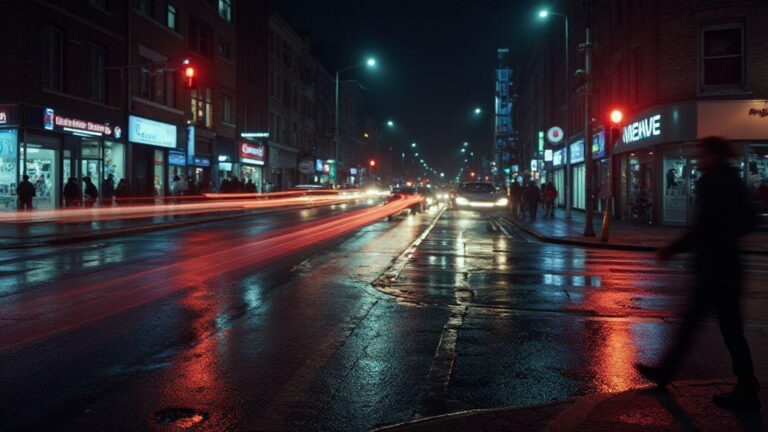

Best Compositions for Urban Night Photography: Beginner to Advanced
Urban Night Photography Compositions Basics
When you start exploring urban night scenes, you’re chasing how light shapes space. You’ll notice tall buildings, glowing windows, neon signs, and moving traffic all work together. Your goal is to guide the viewer’s eye from a strong foreground into a dynamic background. Use bold lines from street lamps, bridges, or silhouettes to lead the gaze, and balance bright light with dark shadows so nothing feels flat. Practicing in different neighborhoods helps you see how color, texture, and reflections change the mood without chasing gear upgrades.
Timing matters as much as camera settings. In the city, crowds, reflections, and the rhythm of traffic give you natural motion. Wait for reflections in rain-slick streets or storefront glass to create a path for the eye. If a scene feels busy, simplify by focusing on one clear subject—like a lone cyclist under a streetlight—so your composition stays intentional. With practice, you’ll recognize a good frame in seconds.
Think in layers. A strong urban night frame often has a foreground element, a middle ground, and a background glow. A foreground might be a railing, a puddle, or a bakery sign. The middle ground could be a person walking or a bus door opening. The background is the skyline or bright windows. Layering builds depth and makes a simple scene feel rich.
Night Photography Composition Techniques for Beginners
Start with the rule of thirds, but adapt it for night by prioritizing light and shape over strict gridlines. Place your brightest element off-center to draw attention, then use leading lines like roads, fences, or building edges to pull the eye toward your subject. Let glare or neon become a signpost that anchors the frame rather than a distraction.
Texture and contrast are your allies after dark. A streetlamp’s glow can turn a brick wall into a tactile map. Seek reflections in puddles or glass to add depth without clutter. If the photo feels flat, shift your angle to catch a brighter reflection or wait for a passing car to introduce controlled motion blur. A simple foreground helps your subject pop amid the city’s theater of lights.
Don’t fear negative space. Empty sky above a tall tower or a quiet alley can emphasize scale and mood. If your subject is a person or statue, give them space to breathe in the frame. Quick checks: is the main light pointing at your subject, and are the shadows shaping form in an interesting way?
Beginner Night Photography Composition Guide Essentials
Essentials start with a steady base: a tripod and a timer or remote. Lock exposure without shake, especially at longer shutter speeds. Set a low ISO to keep noise down, then use a longer exposure to capture glow and movement.
Choose a focal point and keep it sharp. Auto Focus can hunt in the dark, so switch to manual focus or use live view on a bright detail to lock focus. After locking focus, crop tightly to remove distractions or widen to show context like neon signs. Shoot RAW and keep white balance clean to preserve mood.
A practical habit is to scout scenes during blue hour, then return after dark when the lights are on. Rain changes the game—wet streets reflect light and offer fresh composition opportunities without extra gear.
Simple Framing Checklist
- Identify a clear subject and place it off-center using the rule of thirds.
- Look for leading lines that guide the eye toward the subject.
- Check reflections and shadows for depth, not clutter.
- Ensure the brightest element supports the mood and doesn’t overwhelm the scene.
- Keep a simple foreground to frame the main subject.
Use Leading Lines in City Nights
When you head out after dark, your best friend is a line that guides the eye. Leading lines can turn a simple street scene into a powerful photo by pulling your viewer toward the focal point—whether that’s a person, storefront, or neon glow. Road edges, sidewalks, and building corners act as arrows pointing to your subject. Lines are everywhere when the city lights glow.
Lines create rhythm and movement. Bold contrasts—bright street lights against dark pavement—make lines stand out. Place your subject at the intersection of two converging lines for instant depth and balance. Walk the block to spot lines that lead the viewer from foreground to background. Your eye travels the scene, guided by these invisible rails.
Practice spotting lines quickly. Compare a clean curb edge with a busy storefront and choose the line that gives your frame direction. Some streets curve gently, creating a natural path for the eye. Frame so the line begins and ends in the picture; if a line disappears behind obstacles, adjust your angle or wait for a crossing pedestrian to complete the terminus.
Using Streetlights as Leading Lines — Urban Night Photos
Streetlights form bright, repeatable guides that work even in cluttered scenes. Place your subject along the line of light so the eye moves toward them. Shoot from a slight angle to exaggerate perspective, making lamps appear to march toward your focal point. Use a wide aperture to keep lights vivid while keeping the subject crisp in the foreground. For drama, stack several lampposts in a row and align their tops to form a dotted path toward your subject.
Streetlight halos also act as secondary lines. Don’t crowd your frame; let some lamps fade into the background. A sharp subject with softer lights creates depth and mood. Map a route where you can walk beneath a canopy of glowing bulbs for layered lighting that adds three-dimensional feel.
Rail Tracks and Sidewalks to Draw the Eye
Rail tracks slice through a scene and pull viewers toward the horizon. Get low to emphasize the lines and lengthen the perspective. Align the rails with your distant subject so the eye follows the metal ribs toward the focal point. Sidewalks are versatile lines you can use without special access. A long straight sidewalk can run toward a storefront glow or neon sign. Step back to exaggerate perspective, or crouch to place a strong line in the foreground. Use crosswalks and curb edges to frame your subject cleanly. For a quiet mood, choose a sidewalk with few pedestrians so the line stays uninterrupted.
Place Lines for Strong Depth
Maximize depth by leading from the foreground through midground to the background where your subject sits. Think of the frame as a tunnel the viewer looks through. Align a street edge or railing with your camera axis, then let a distant light source complete the depth cue. If lines run parallel to the sensor, they flatten; tilt slightly to add perspective. Shoot early in blue hour to let lines glow without washing out. Include a clear foreground element to anchor depth.
Long Exposure City Composition
Frame a city night scene with layers that tell a story: quiet foreground, glowing middle ground, and busy background. Use a low ISO and a small aperture to keep detail from front to back, then open up just enough to let lights pop without washing out the sky. Think of your frame as a postcard you’re stitching in the dark—every piece must contribute to the story. Balance color temperature, reflections, and streetscape rhythm so viewers feel like they’re walking the scene with you.
When composing, look for movement that guides the eye. Street lamps’ soft glow can arc through the frame, while glass facades create vertical lines that echo the skyline. Use a wide or standard lens to capture context—you want the scene to feel alive, not cramped. If you include a person or car, place them off-center to add scale without stealing attention from the city’s heartbeat. The best compositions for urban night photography—from beginner to advanced—come from knowing where to place light, shadow, and negative space to keep the image readable at a glance.
Color balance matters. Neon signs, traffic lights, and storefronts cast different hues. Aim for a cohesive mood: cool blues with warm amber can feel cinematic and inviting. If light blooms or halos appear, embrace them as atmosphere rather than flaws. The right exposure lets colors sing.
Long Exposure City Composition for Light Trails
Light trails are the heartbeat of a city at night. With a low ISO and small aperture, longer shutter speeds paint trails across the frame. Longer exposures yield continuous ribbons; shorter produce segmented lines. Frame, lock focus, start the exposure, and watch the city write its story.
Practice reveals where trails look best: side streets with steady flow or a bridge with reflections. To avoid overexposure on bright signs, consider a neutral density filter or underexpose slightly and recover shadows in post. If a moving subject nears the frame edge, time the shutter so trails don’t collide with it.
Control Shutter Speed and Motion Blur
Shutter speed governs motion. Faster freezes; slower reveals. For trails, use longer exposures to let lights paint the air. For subtle motion blur in clouds or water, extend exposure further. Balance trail length with competing details in the scene, and adjust aperture and ISO accordingly. Test a few frames to lock in a crisp static area and dreamy motion where appropriate.
Tripod and Timing Basics
A tripod keeps the frame sharp during long exposures. Use a remote or timer to avoid shake. Scout timing: look for city life at peak or during transit moments. Press shutter and let the city unfold. If you miss a moment, note what timing to adjust next time.
Framing and Layering Night Cityscapes
Framing is your roadmap. Start with a strong main subject—bridge, facade, or neon sign—and build around it. The framing should feel intentional, not crowded. Look for lines that lead toward your focal point, such as a boulevard narrowing into the distance or arches that draw you deeper into the scene. This is where the eye moves naturally, and your camera records the path.
Layering is your secret weapon. Think foreground, midground, and background as separate stories happening at once. In the foreground, place texture or silhouette to add depth. The midground carries main action or subject, while the background provides context with distant towers or a glowing sky. When you align these layers, the image reads as real, not flat.
Brightness and contrast guide layering at night. If the foreground is too bright, it dims the others; if the background blazes, the subject can vanish. Use reflections on wet streets as a subtle bridge between layers. Balance is key. Include a foreground element to anchor depth and give a sense of place.
Framing and Layering Night Cityscapes with Arches
Arches add architectural rhythm to stack layers. Place an arch in the foreground as a frame that leads the eye to the midground and background. Keep the arch uncluttered; a single light can create a crisp silhouette.
Use arches to create repeating patterns. Shoot straight on to emphasize cadence, or angle slightly for perspective. Each arch acts as a doorway into the layers beyond, giving the night shot a tangible flow. Consider shadows: dark interiors between arches provide negative space that makes the lit street or tower pop. If possible, align an arch with a bright sign to lightly illuminate the interior without overpowering the subject.
Stack Foreground, Midground, and Background
Make each layer tell part of the story. In the foreground, place a sharp texture or silhouette—bike, planter, or railing. The midground carries main action, like a moving tram or a couple under a streetlamp. The background adds context with skyline silhouettes or a glowing cityscape.
Keep distance between layers intentional. If too close, the photo feels cramped; too far apart, you lose connection. A small aperture keeps layers reasonably in focus, but don’t hesitate to open up for a dreamy background if the foreground is strong.
Light acts as glue when stacking. A midground streetlamp can create a line of highlights that threads through to the background. A puddle’s reflected glow can link foreground texture with distant lights, making the scene cohesive.
Create Depth with Light
Light is your depth tool. Use warm and cool tones to separate layers: warm streetlights against cool shadows read as depth. Let a bright window glow behind a foreground silhouette so the subject stays crisp while the rest softens.
Experiment with direction. Side lighting on the foreground adds texture; backlighting the midground subject can create a luminous rim that helps it pop. If you’re near glass or wet pavement, reflections can double the light and add depth you control with angle.
Vary exposure to prevent highlights from blooming. You want enough brightness to read shapes without washing out arcs of light. A gentle touch preserves detail across all layers and depth in the night cityscape.
Add Foreground Interest at Night
Paragraph 1: Foreground elements grab attention and add depth. Place a well-chosen foreground in the lower third; city shapes like curbs, railings, or a bench glow with streetlight reflections, making the scene feel alive.
Paragraph 2: A strong foreground anchors the moonlit background. Include edges with clear forms, like a wire fence or a puddle reflecting neon. This gives the eye something practical to latch onto and makes the composition feel intentional.
Paragraph 3: Don’t overdo it. If the foreground overwhelms, the eye won’t rest. A single bold foreground element often delivers the strongest impact at night. Keep it sharp where it matters and let the foreground guide the eye without stealing attention.
Foreground Interest Night Photography with Props
Paragraph 1: Props can transform a plain street into mood. A small bicycle, a street vendor cart, or a lone chair offers tactile anchors in the dark. Place the prop closer to the camera than the main subject to create a layered look. Light will wrap around the prop, adding texture and atmosphere.
Paragraph 2: Props tell a story. A discarded umbrella, a flickering sign, or stacked crates conveys a moment in time. Expose them just right—enough light to read texture but not so much that you wash out the scene. The goal is a present foreground, not a stage prop.
Use People or Objects for Scale and Story
Paragraph 1: People in the foreground add scale and motion without stealing focus. A silhouette of a passerby, a worker at a railing, or a couple holding hands can anchor the frame. Time a shot as someone passes to add a tiny city moment, making the scene more relatable and magnetic.
Paragraph 2: Objects also work for scale and story. A streetlight, a street sign, or bollards show how big the city feels at night. Placing an object at the front guides the viewer’s eye toward the action beyond. This tug-of-war between foreground and background makes your Best Compositions for Urban Night Photography: Beginner to Advanced feel deliberate and polished.
Set Focus and Aperture
Paragraph 1: Focus is the compass at night. Choose a clear foreground item you want sharp, then stop down or open up depending on depth you want. For a strong foreground with a softly blurred background, use a wider aperture. For both foreground and background sharp, pick a smaller aperture and increase distance between subject and foreground. Test a few shots to see how light behaves on your lens.
Paragraph 2: Hyperfocal thinking helps street scenes. With a standard zoom, set focus to roughly one-third into the scene to keep foreground and distant lights reasonably sharp. Practice on evening walks to build confidence and storytelling through focus choices.
Symmetry and Reflections in Urban Nights
When you head out at night, symmetry becomes your best friend. Look for axial symmetry in central streets, lamppost rows, or mirrored towers. Place the horizon along a clean line and let mirrored elements do the heavy lifting. The best shots feel deliberate, like a designed poster rather than a street snapshot.
Reflections add a second layer of interest. In puddles, storefronts, or glass facades, you see two worlds—the real and its reflection. Control the angle so reflection aligns with the subject for clean vertical symmetry or a pleasing diptych. If reflections look distorted, adjust your stance for a cleaner mirror image.
To make symmetry and reflections feel intentional, use leading lines to guide the gaze toward the center. Keep the camera level and horizon positioned. If shooting handheld, use a shorter exposure to freeze movement and avoid blurred reflections. Locking symmetry and treating reflections as part of the rhythm makes city nights look polished.
Symmetry and Reflections in Urban Nights in Puddles
Puddles turn a dull alley into art. Crouch low or find a vantage where the water’s edge lines up with the subject. Shoot at a low angle so the puddle absorbs the skyline’s glow. A still surface yields crisper reflections. Weather matters—rain or moisture provides the best opportunities. Tilt or reposition to reduce clutter and let the water act like a mirror that strengthens the composition. In post, enhance symmetry carefully; avoid over-sharpening to keep water texture natural. If multiple reflections exist, crop to keep the strongest one and maintain a clean composition.
Glass Facades and Mirrored Buildings
Glass facades invite urban night symmetry. Seek repetitive window patterns that line up across floors and capture both the real scene and its reflection. If reflections become busy, isolate a single vertical column of windows. Straight horizons help reflections feel intentional. For tall subjects, place the horizon low to emphasize reflection, or high to keep the real scene from overpowering the mirror. Experiment with angles; a slight shift can transform messy reflections into crisp, layered compositions. Be mindful of glare—use a polarizer or adjust your angle. Shoot during blue hour or after dark for soft, even reflections.
Align Horizon for Clean Reflections
Keep reflections tidy by aligning the horizon. A level horizon helps the mirrored city read as deliberate. Use a railing or rooftop edge as a reference. Small adjustments can turn a busy shot into a clear read at a glance.
Apply Rule of Thirds in Night Scenes
You gain balance by placing key elements along gridlines. The rule of thirds helps photos feel natural even when lights and motion swirl around you. Align a bright building edge, street lamp glow, or moving car along a vertical gridline to guide the eye smoothly. Practice mentally dividing the frame into nine blocks and decide where the viewer should land.
In the city at night, intersections are powerful anchors. If downtown, place a tower or billboard near a grid meeting point. If by a river, let the horizon sit on a horizontal line with the brightest boat or bridge light on a third-point. The more you experiment with intersections, the more natural your compositions feel, even in fast-moving scenes.
Enable grid view on your camera to help align important lights with gridlines or intersections. This creates a deliberate read and a stronger story in every shot.
Rule of Thirds Night City Photography for Balance
Tall structures anchor the vertical thirds. Let a bright sign ride along the right third, or a lamppost sit on the left. Negative space—like dark skies or quiet streets—provides balance to bright elements. When adding people or vehicles, place them near intersections to keep motion off-center but purposeful. A diagonal rhythm from a slight tilt can add energy, but keep the grid in mind to maintain balance. See your scene as a seesaw: brighter elements on one side need counterbalance on the other.
Combine the Grid with Negative Space
Negative space gives your subject room to breathe and highlights color, texture, and motion. Pair it with a grid to guide the eye while leaving atmosphere room. For example, park lights along the top with a lone silhouette on the bottom third creates contrast and mood. Negative space can emphasize scale—a skyscraper against a wide dark sky can feel taller. Let empty street space lead toward a glowing horizon to imply depth. Avoid crowding the frame with too many bright elements; space around them often tells as much as the subjects themselves.
Place Points of Interest
Anchor your frame by placing the main subject on a grid intersection or along a gridline. Bright storefronts, lit bridges, or solitary street lamps serve as anchors. If crowds form, frame with a break in traffic to guide the eye to the point of interest. Use leading lines—roads, railings, or reflections—to push toward the subject. When photographing people, place them near a grid point but allow space for natural movement. With practice, you’ll instinctively place the focal point where it sings. Keep the entire scene visible and balanced to create a memorable night shot.
Advanced Composition Tips for Urban Night
You already know city lights can transform a shot, but you can push your composition further after dark. Focus on how shapes and colors interact, not just what’s lit. Place your subject off-center for dynamic balance, and let reflections from windows, rain, or wet streets guide the eye toward the moment you want to freeze. Keep backgrounds simple but meaningful—a clean skyline or a single glowing storefront—to anchor the frame without stealing attention. Use leading lines—building sides, cables, or crosswalks—to pull the viewer in and toward the moment you want to freeze. Create a story in a single frame, not a collage of elements.
Think in layers: foreground, middle ground, and background. A bright neon distant in the distance can be exciting, but give the foreground an anchor, even a small silhouette or puddle mirroring lights. A well-balanced layer setup makes the eye travel through the photo and settle on the key detail. Don’t fear negative space; a touch of dark air around bright spots enhances contrast and drama. Use a steady rhythm of light and shadow—car streaks, flickering signs—to create tempo you feel as you scan the image.
Gear helps, but your eye matters more. Try different focal lengths to see how compression changes mood—a wide view for cityscapes, or a tight frame isolating a neon sign. A tripod helps with long exposures that feel quiet; handheld shots keep things lively. The best compositions for urban night photography come from listening to the city’s pulse and choosing moments that resonate with your story. Keep experimenting, and your frame will fill with purpose.
Advanced Composition Tips: Using Color Contrast
Color after dark is a secret weapon. Balance warm lights with cool shadows for a cinematic feel. Look for warm orange signs against blue storefronts, or magenta neon on wet pavement. Let one color dominate if that helps guide the gaze. Midtone grays and deep blacks provide quiet spaces to make bright colors pop. Use low ISO with slower shutter to retain color richness while minimizing noise.
Experiment with color temperature to set mood. Cooler tones push a futuristic vibe; warmer casts feel intimate. Adjust white balance toward tungsten for cozy streetlamp glow or toward blue to emphasize neon. When color contrast is strong, your photo reads quickly and clearly, even at a glance. The city is loud; color choices are how you whisper your message.
Blend Motion and Still Elements for Drama
Motion can build drama when choreographed with still elements. A cyclist past a static storefront can feel like a living painting. Use a slower shutter to blur movement slightly, then sharp focus on a foreground or subject to preserve drama. Let moving buses or ads guide the eye toward the main subject. For a calmer feel, let pedestrians move in the distance while the foreground stays crisp. Timing is key—anticipate movement, press the shutter, and let the street do the rest.
Frames with motion teach patience: wait for a light change or a passing car to leave a clean line across a wet street. Balance energy with a well-composed still element to achieve a deliberate final image.
Test Bold Framing Ideas
Bold framing makes night photos stand out. Try placing your subject in unusual spaces—inside a doorway frame, between two bright signs, or along a storefront window. A strong frame makes a simple subject feel powerful and intentional.
Crop aggressively in-camera to remove distractions and center the subject in the tension of the scene. Reflections in glass or water can serve as extra framing devices, adding mystery as light bounces between real and reflected surfaces.
Vary your angles. Kneel to capture street glow from a new perspective, or shoot from a higher spot for a bird’s-eye view of gridlines and traffic. A small framing change can yield a big narrative shift.
Plan, Gear, and Safety for Night Shoots
Plan before you head out. Decide the mood you want, the lights you’ll chase, and how you’ll move between spots. Set two goals and a backup idea to stay focused and avoid wandering. This map helps you achieve repeatable results.
Choose gear that matches your goals: a solid camera with strong high-ISO performance, a reliable tripod, and a fast lens for dim scenes. Bring extra batteries and memory, a red-setting headlamp for night work, microfiber cloth, gaffer tape, and zip ties to fix small issues on the fly. Weather protection is essential; a waterproof cover keeps reflections intact. Your setup should feel like a trusted toolkit.
Safety at night is non-negotiable. Scout routes in daylight when possible, stay visible with reflective gear, keep valuables secure, and let someone know your plan. If a spot feels unsafe, move on.
Scout Locations for Urban Night Photography Compositions
Choose spots with glowing contrasts: reflections in windows, wet streets, or moving traffic trails. Foreground elements like signs, benches, or bike racks add depth. Walk the area, test angles, and imagine how a tall building, a lighted sign, and a passing bus will look in one frame. In crowds, a clean composition with a strong lead line often works better than chaos. Timing matters too: some spots shine after sunset; others during blue hour. Use a mental grid of left/right thirds and vertical lines from lamps to add drama. If possible, shoot from elevated spots to capture a wider cityscape.
Pack Gear and a Simple Safety Checklist
Pack light but smart: tripod, versatile lens, extra batteries, and memory cards. Add a remote or intervalometer to reduce shake. A rain cover, microfiber cloth, and collapsible reflector help tame tricky reflections. Keep lens cloths handy.
Safety checklist: ensure paths are well-lit, there are witnesses nearby, a buddy is within sight, and you have a retreat plan. Lock your bag, avoid flashing valuables, and stay aware of surroundings. If something feels off, move to a safer spot or call for a ride.
Quick Post-Process and Safety Steps
Keep edits minimal and true to night mood. Start with a clean white balance that respects neon and streetlights. Slightly boost shadows to recover detail, and adjust exposure to preserve highlights. Subtle clarity helps textures pop without overdoing it. Use light denoise if needed and keep color balance natural to avoid muddy tones. Save a RAW copy before editing.
Safety in processing: back up to two locations and keep RAW originals separate from edits. Use strong passwords and keep an updated gear inventory. If sharing online, consider a watermark but keep metadata clean so editors can reach you.
Best Compositions for Urban Night Photography: Beginner to Advanced is a living guide that grows with your practice. By focusing on framing, layering, color, and light, you’ll build a portfolio that tells your city’s story with intention and artistry.

Smartphone Night Photography Enthusiast & Founder of IncrivelX
Vinicius Sanches is a passionate smartphone photographer who has spent years proving that you don’t need an expensive camera to capture breathtaking images after dark. Born with a natural curiosity for technology and a deep love for visual storytelling, Vinicius discovered his passion for night photography almost by accident — one evening, standing on a city street, phone in hand, completely mesmerized by the way artificial lights danced across wet pavement.
That moment changed everything.
What started as a personal obsession quickly became a mission. Vinicius realized that millions of people were carrying powerful cameras in their pockets every single day, yet had no idea how to unlock their true potential after the sun went down. Blurry shots, grainy images, and washed-out colors were robbing everyday people of memories and moments that deserved to be captured beautifully.
So he decided to do something about it.
With years of hands-on experience shooting city streets, starry skies, neon-lit alleyways, and creative night portraits — all with nothing but a smartphone — Vinicius built IncrivelX as the resource he wished had existed when he was just starting out. A place with no confusing jargon, no assumptions, and no gatekeeping. Just honest, practical, beginner-friendly guidance that actually gets results.
Vinicius has tested dozens of smartphones from every major brand, explored dark sky locations across multiple states, and spent countless nights experimenting with settings, compositions, and editing techniques so that his readers don’t have to start from scratch. Every article on IncrivelX comes from real experience, real mistakes, and real lessons learned in the field.
When he’s not out shooting at midnight or writing in-depth guides for the IncrivelX community, Vinicius can be found exploring new cities with his phone always within reach, looking for the perfect shot hiding in the shadows.
His philosophy is simple: the best camera is the one you already have — you just need to learn how to use it in the dark.