
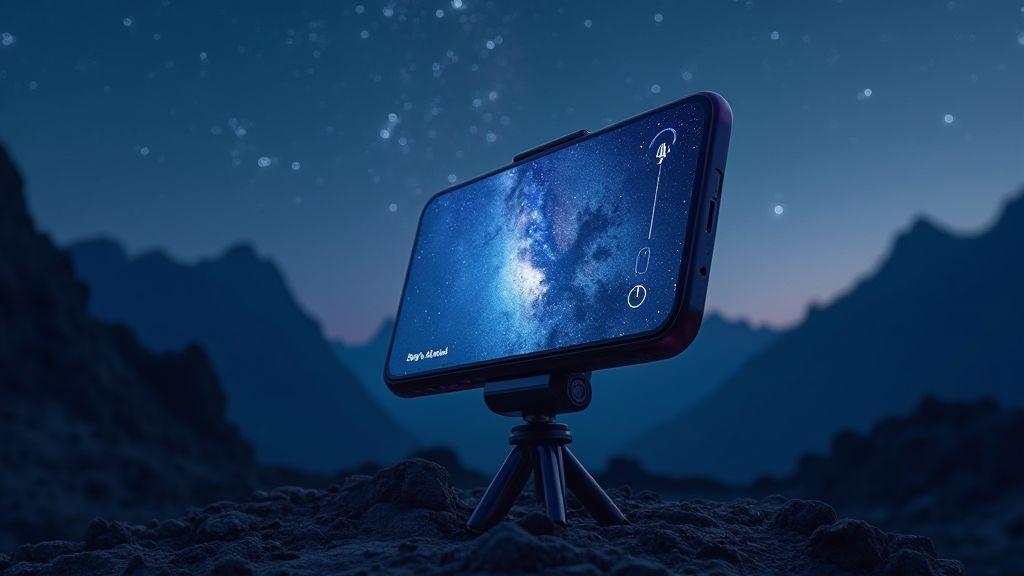
Top Astrophotography Apps for 2026: Unleashing the Power of Pixel 10 Pro and Beyond
When capturing the night sky with the Pixel 10 Pro, you want apps that balance RAW capture, quick controls, and low-light tricks. This guide on Top Astrophotography Apps for 2026: Unleashing the Power of Pixel 10 Pro and Beyond helps you keep the sky front and center, letting you shoot, adjust, and review without slowing down.
You’ll see two kinds of apps: RAW-capable photo apps and long-exposure helpers. RAW keeps all the data the sensor sees for post-processing, while long-exposure tools can stack frames to reduce noise and reveal star trails or faint galaxies. Look for fast, stable apps with clean interfaces, reliable focus aids, and easy access to ISO, shutter, and white balance. The right lineup lets your night sky shine with clarity, color, and mood, without hours of fiddling.
If you’re serious about night shots, pick apps that work well with Pixel 10 Pro’s sensors and processing. Look for histogram feedback, lens corrections, RAW capture with minimal compression, and quick presets or custom profiles so you’re not reinventing the wheel every time you head outside. The goal is consistent performance so you can spend more time composing and less time chasing settings.
Check RAW support and Pro controls
RAW support is essential for clean edits later. Choose apps that export true RAW or lossless DNGs, not just heavily processed JPEGs. For the Pixel 10 Pro, prefer apps offering direct RAW capture with preserved white balance and exposure data. Pro controls—knob-like access to ISO, shutter speed, focus, and exposure comp—save you from menu-hunting in the dark. Being able to grab a frame, tweak essentials, and avoid shadow clipping or highlight blowouts makes every shot feel easier.
In practice, test a couple of settings quickly in the field: shoot a dark sky with high ISO and a longer shutter, then switch to low ISO and shorter shutter to compare. Pro controls should respond quickly without lag. If critical options are buried behind menus or processing is overly aggressive, it’s not ideal. Your aim is neutral skies you can color-correct in post, not baked-in purple nebulas you can’t undo.
Compare long-exposure apps for Pixel 10 Pro
Long exposure is where night photos come alive. Compare how each app stacks images, handles noise, and preserves star details. Look for automatic stacking, light-frame previews, fixed exposure sequences, and reliable motion estimation for smooth star trails. Check whether you can save sequences as a single multi-frame file or export them individually, and whether there’s a clear progress indicator you can pause or cancel without losing settings.
Real-world performance matters: some apps pause to process, breaking your rhythm. You want one that stays responsive so you can keep shooting while stacks process in the background. If you plan star trails, ensure the app supports lengthy exposures and manages battery usage without overheating. Your long-exposure tools should feel like steady partners, not hindrances.
Quick app checklist
- Ensure RAW capture and flexible white balance
- Pro controls accessible without digging through menus
- Reliable stacking and noise reduction for long exposures
- Stable performance on Pixel 10 Pro with minimal lag
- Clear previews and histograms to guide exposure decisions
Use smartphone star-tracking apps for precise framing
Smartphone star-tracking apps let you frame night shots with accuracy by showing constellations and star trails on screen. This reduces guesswork when balancing foreground with the sky and helps you frame for specific meteor trails or Milky Way arcs. Look for apps that display celestial coordinates and live overlays to align brightest stars with your composition. A tracking app helps you maintain precision even if the phone drifts during a long exposure, saving time and reducing wasted frames.
Sync phone sensors and GPS for accuracy
Your phone’s sensors and GPS do heavy lifting when you map stars to your exact location and orientation. Calibrate compass and gyroscope, grant necessary permissions, and re-check alignment after moving. Pairing GPS with live tilt data helps predict star drift in your frame, guiding you to start at the right angle for clean trails.
Mount, guide app, and live alignment tips
A small tripod or magnetic mount keeps your phone steady while you guide the shot. Use live alignment to nudge the frame precisely, then adjust exposure in real time to protect highlights and foreground. If you spot a bright satellite, pause briefly to avoid blur. Practice with test frames before a long night session, and team up with a friend for a fresh perspective.
Stack with mobile astro stacking apps for your images
Starlight-friendly stacking apps let you chain multiple exposures into a cleaner image without heavy gear. Start with short, evenly spaced frames, then stack to reduce noise and sharpen star points. Real-time alignment features help lock onto bright trails and compensate for tiny movements. If handheld, use forgiving registration to smooth frames; dashboards should show stack progress and estimated noise reduction.
As you stack, you’ll notice color balance improve. With practice, you’ll discover which exposure lengths blend best with your camera and weather, and your workflow will feel automatic: shoot, load, stack, tweak, repeat. A sharper Milky Way comes with consistent practice.
Choose apps for dark frame and alignment
A good app handles dark-frame calibration and precise alignment. Look for dark-frame libraries linked to your camera model and ISO, plus real-time multi-frame alignment (auto-registration, star-pattern recognition, region of interest). Try both automatic and manual alignment to see which gives you tighter results. Dark frames save time by letting you reuse calibrations across sessions, keeping your workflow lean and ensuring a clean, noise-free sky.
Best astrophotography apps 2026 for stacking
The top stacking apps in 2026 balance ease of use with powerful features: dark-frame subtraction, batch processing, and 16-bit exports. A strong interface helps you focus on the sky rather than the screen, with robust noise reduction and flexible stacking modes (average, median, sigma-clipping) and real-time auto-alignment plus manual fine-tuning.
Battery life and offline capability matter when you’re far from a charger. An efficient export path that preserves dynamic range and color helps you post-process with flexibility. The right app should feel like a trusted co-pilot on your night photography journey.
Stacking tips
- Keep frames evenly exposed; avoid brightness shifts across shots
- Use dark frames to reduce hot pixels; include flat frames if supported
- Align stars carefully; even small drift can blur the Milky Way core
- Stack more frames when possible for better noise reduction
- After stacking, tweak contrast and brightness gently to maintain realism
Apply AI noise reduction for astrophotography to your shots
AI denoise helps reduce grain without washing out faint nebulae and star cores. Start light on a representative shot to gauge how it affects sky and stars. Apply denoise in layers: denoise the individual frames, stack, then apply gentle denoise to areas where noise stands out. Check color consistency across the frame to avoid hue shifts. If the sky is very dark, you may need less denoise; if you have heat noise, adjust strength regionally to protect delicate structures.
Always zoom to 100% to ensure no haloing around stars and that dust lanes remain intact. If the sky looks too smooth, back off and try a different mask or selective denoise.
When to run AI denoise on mobile
Denoise after stacking and alignment when editing on a phone. Mobile apps handle noise differently, so start with a light pass and preview at around 50% before committing. For best control, finalize on a desktop.
Compare AI noise reduction tools for astrophotography
Different tools treat detail and noise uniquely. Test a few on the same shot and compare at 100% to see how nebulae and star fields hold up. Look for preserved color in faint areas and crisp star cores. Choose a tool that preserves a natural look rather than a processed one.
Consider your publishing goals: social might tolerate a smoother look, while prints demand richer texture and color. Keep notes on settings to reproduce the look across nights.
Noise vs detail balance
Balance denoise to quiet grain without losing delicate details. Start with small adjustments and compare. If dark lanes still show grain, localize noise reduction to those areas rather than the whole image. The aim is a natural sky with preserved star structure and nebular detail.
Shoot RAW night sky photography Android on your Pixel
RAW captures all sensor data, enabling post-processing to pull star detail, Milky Way color, and subtle haze. Use apps that save RAW directly and keep ISO low to avoid excess grain. Plan scenes with enough brightness to reveal color without washing out the stars. RAW night-sky work on Android shines when you compare RAW to JPEG: RAW preserves subtle glow and facilitates deeper stacking.
Use Pixel 10 Pro RAW DNG and exposure bracketing
Pixel 10 Pro RAW DNG preserves full sensor data and yields richer color and detail. Pair RAW DNG with exposure bracketing to capture both bright stars and dark foreground. Bracketing lets you shoot multiple exposures at different levels and blend them for even detail. Set RAW capture to DNG, enable bracketing, and shoot three to five frames with identical framing and low ISO.
Process the frames with stacking or HDR blending to achieve a sky glow with clean foreground. Watch white balance carefully; the sky often shifts blue while the ground warms up. Save a neutral final color space version for cross-device consistency.
RAW night sky photography Android workflow
A stable tripod, clean lens, and RAWDNG are your starting points. Use manual focus at infinity and remote shutter release to avoid shake. Shoot bracketed frames to cover dynamic range, then stack and blend to reduce noise while preserving color in the sky and detail in the foreground. After stacking, color-correct and adjust contrast for a natural look.
Save a master RAW file and export variations for sharing. Document exposure bracketing, ISO, and shutter settings so you can reproduce the result on future nights.
RAW workflow steps
- Prepare: Dark site, tripod, RAW in DNG, focus at infinity, 2–4 second timer
- Shoot: Bracketed set (-2, 0, 2 EV) at low ISO, longer shutters
- Stack: Import RAW DNGs, align, blend to reduce noise; ensure color consistency
- Edit: Color correction, white balance, tone mapping on a neutral base
- Export: High-res RAW master and shareable JPEGs; note settings for replication
Edit with astrophotography editing apps mobile for the final image
Transform night shots with mobile editing apps by stacking your best frames and controlling noise, color balance, and star shaping. Keep stars sharp while pulling detail from shadows. Avoid over-sharpening; aim for a natural look that still pops on social feeds. A good workflow: adjust exposure, then tone curves, then color science to keep the Milky Way distinct. If your device uses heavy computational photography, use it to your advantage but retain fine-tuning control in the app.
Respects the scene: separate highlights from shadows, maintain correct white balance (night skies skew blue or magenta). Save a neutral version and a bolder one for quick comparisons. Predefine mobile presets for Milky Way or deep-sky shots to speed up future edits. Use your gallery’s compare view to avoid over-editing. The final image should look bright and real, suitable for portfolios and social channels.
Tune color and contrast for low-light landscape astrophotography apps
Color tuning bridges a flat night scene to a lively sky. Deepen sky blues near stars while preserving foreground tones. For landscapes, slightly warm the ground to anchor the image, keeping the sky cooler for realism. Gentle contrast with an S-curve can boost detail without exaggerating grain. Avoid oversaturation, especially of blue stars and nebulae. Use masks to apply adjustments to the sky only, preserving a warm foreground. A cool sky with a warm foreground reads well on mobile screens and across platforms.
Export for deep sky imaging smartphone 2026 and social
Export settings matter for both deep-sky detail and social sharing. Choose high-resolution exports (RAW or TIFF if available); JPEGs compress detail and can flatten nebulae. Create platform-optimized versions for social posts, plus a master file for prints. Maintain the original layered project for future edits. If exporting on mobile, keep files as uncompressed as possible; lightly compress only if needed and verify on a larger screen.
Two versions work well: a clean version for galleries and a bolder version with a bit more grit for social feeds. Watermark sparingly to protect your work without cluttering the image.
Final edit checklist
- Confirm white balance is accurate for sky and foreground
- Check noise levels and apply denoise judiciously
- Ensure stars are sharp, not bloated by sharpening
- Adjust color balance to avoid casts in sky and ground
- Keep foreground natural, not washed out
- Preserve nebula and dust detail without clipping highlights
- Export high-resolution masters for archives and optimized versions for social
This streamlined guide on Top Astrophotography Apps for 2026: Unleashing the Power of Pixel 10 Pro and Beyond helps you choose the right tools, optimize your Pixel 10 Pro workflow, and create stunning night-sky imagery that stands out across platforms.

Smartphone Night Photography Enthusiast & Founder of IncrivelX
Vinicius Sanches is a passionate smartphone photographer who has spent years proving that you don’t need an expensive camera to capture breathtaking images after dark. Born with a natural curiosity for technology and a deep love for visual storytelling, Vinicius discovered his passion for night photography almost by accident — one evening, standing on a city street, phone in hand, completely mesmerized by the way artificial lights danced across wet pavement.
That moment changed everything.
What started as a personal obsession quickly became a mission. Vinicius realized that millions of people were carrying powerful cameras in their pockets every single day, yet had no idea how to unlock their true potential after the sun went down. Blurry shots, grainy images, and washed-out colors were robbing everyday people of memories and moments that deserved to be captured beautifully.
So he decided to do something about it.
With years of hands-on experience shooting city streets, starry skies, neon-lit alleyways, and creative night portraits — all with nothing but a smartphone — Vinicius built IncrivelX as the resource he wished had existed when he was just starting out. A place with no confusing jargon, no assumptions, and no gatekeeping. Just honest, practical, beginner-friendly guidance that actually gets results.
Vinicius has tested dozens of smartphones from every major brand, explored dark sky locations across multiple states, and spent countless nights experimenting with settings, compositions, and editing techniques so that his readers don’t have to start from scratch. Every article on IncrivelX comes from real experience, real mistakes, and real lessons learned in the field.
When he’s not out shooting at midnight or writing in-depth guides for the IncrivelX community, Vinicius can be found exploring new cities with his phone always within reach, looking for the perfect shot hiding in the shadows.
His philosophy is simple: the best camera is the one you already have — you just need to learn how to use it in the dark.